
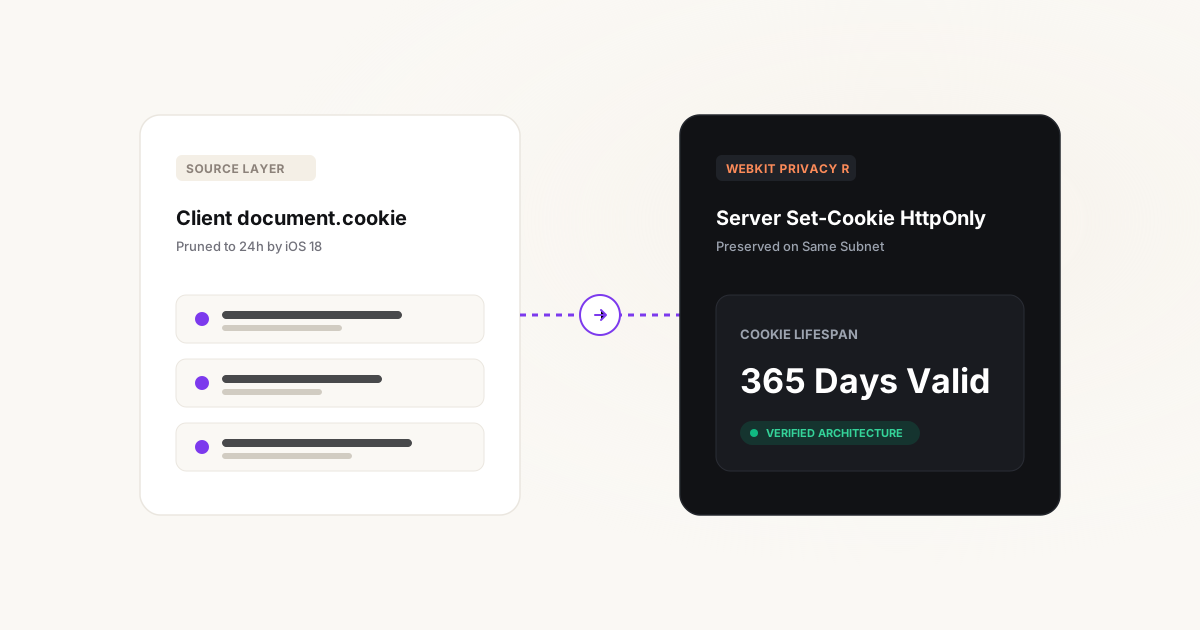
How Safari ITP systematically prunes JavaScript cookies
Apple's Intelligent Tracking Prevention (ITP) was originally conceived to block third-party cross-site tracking cookies. However, as ad-tech networks attempted to circumvent this restriction by setting tracking identifiers via client-side JavaScript (using document.cookie), Apple responded with increasingly aggressive WebKit updates.
Under current Safari ITP 2.4+ specifications, any cookie written via client-side JavaScript is capped at a maximum lifespan of 7 days. Even more aggressively, if a user clicks an ad containing decoration parameters (such as ?gclid=..., ?fbclid=..., ?msclkid=...) and the landing domain is classified by WebKit as having tracking capabilities, the cookie lifespan is slashed to just 24 hours.
The Practical Consequence for High-Ticket Brands
If a buyer discovers your brand via an Instagram ad on Sunday evening, spends 5 days consulting family or reviewing competitor options, and returns on Friday to make an €800 purchase, Safari treats them as a completely new user. The purchase is credited to Direct or Organic search, and Meta receives zero attribution signal to optimize future bids.
First-Party Cookie Defense in Production: Review our Server-Side Tracking & Safari ITP Defense architecture and see how restoring 30-day attribution windows transformed campaign efficiency in the Olivia Garden Case Study (587% ROAS) and Boobon Serverless Attribution Pipeline.
Why simple CNAME cloaking no longer works
When ITP first restricted JavaScript cookies, many vendors recommended "CNAME Cloaking". Merchants created a DNS CNAME record (e.g., tracking.brand.com) pointing directly to a third-party server (e.g., vendor.saas-tracking.com).
Apple quickly countered this workaround in iOS 14 and macOS Big Sur by integrating DNS resolution into WebKit. When Safari connects to a subdomain, it inspects the CNAME resolution chain:
- If the resolved IP address belongs to a completely different Autonomous System Number (ASN) or IP subnet than the root website, Safari flags the connection as disguised third-party tracking.
- Cookies issued across that CNAME boundary are immediately capped to 7 days, rendering naive DNS cloaking ineffective.
The Server-Set HttpOnly cookie architecture
To establish an attribution system that survives Apple's privacy filters, customer state must be governed by an authentic first-party server that returns standard HTTP Set-Cookie response headers.
Under WebKit's documented architecture rules, cookies set via HTTP response headers from the origin server are classified as legitimate first-party session management cookies and are preserved for their full declared lifetime (up to 365 days):
Client-Side document.cookie
CNAME DNS Cloaking
Server Set-Cookie HttpOnly
Building a resilient first-party identity graph
A robust enterprise identity graph operates on three tiers of resolution:
Master First-Party UUID
On the customer's very first visit, your server proxy generates a cryptographically secure UUID (e.g., lu_id) and sets it via an HTTP response header with Secure; SameSite=Lax; HttpOnly.
Click ID & Referrer Persistence
The server extracts incoming click parameters (gclid, fbclid, utm_source) from the request URL and binds them to the master UUID in an in-memory Redis or server-side session cache, protecting them from browser storage deletion.
Deterministic CRM Stitching
When the shopper enters an email address during newsletter signup, cart recovery, or checkout, the server hashes the email using SHA-256 and merges the anonymous historical touchpoints into an authenticated customer profile.
Measuring the revenue impact on 30-day LTV
When our Senior Crew audits mid-market European merchants, we run a baseline comparison between client-side GA4 data and server-preserved first-party identity tables. In high-consideration verticals (furniture, consumer electronics, luxury fashion, B2B software), the discrepancy is staggering:
- Day 1 to 3 Purchases: Client-side tracking captures 92% of transactions.
- Day 8 to 14 Purchases: Client-side tracking captures only 24% of originating ad channels.
- Day 15 to 30 Purchases: Client-side tracking attributes 0% to paid media, miscrediting 100% to Direct.
Deploying server-side cookie defense restores an average of +28% to +42% incremental paid ROAS on longer consideration cycles, giving ad platform algorithms the high-intent signals required to bid aggressively.
Technical implementation blueprint: Cloudflare + sGTM
The gold-standard enterprise architecture utilizes Cloudflare Workers alongside a Server-Side Google Tag Manager container:
- Same-Domain Edge Proxy: Configure a Cloudflare Worker on your root domain route (
brand.com/data-stream/*) that proxies incoming telemetry to your sGTM server. This guarantees that traffic shares the exact same IP pool and TLS certificate as your website. - Cookie Keeper Protocol: On incoming HTTP responses, intercept the
_gaand_fbpcookies, re-writing them as HTTP-only cookies with a 1-year expiration date. - Upstream Payload Enrichment: Inject the preserved first-party identifier into outgoing Meta CAPI and Google Ads Enhanced Conversion payloads server-to-server.
GDPR & CNIL compliance boundaries
A common misconception in the growth industry is that server-side tracking allows brands to "bypass GDPR" or track users without consent. Under European law and strict French CNIL guidelines, this is categorically illegal.
Article 5(3) of the ePrivacy Directive and GDPR principles apply to the storage or retrieval of information on a user's terminal equipment, regardless of whether the processing is executed client-side or server-side:
- If a user clicks "Refuse All" on your cookie banner, your server container must strictly drop all advertising identifiers and suppress Meta CAPI transmission.
- Server-side tracking should be used to protect data quality for consented users, ensure IP anonymization, and maintain data sovereignty within the EU—never to circumvent user rights.
Frequently asked questions
Does Safari ITP affect Google Chrome or Android users?
No. ITP is exclusive to Apple WebKit, meaning it affects all browsers on iOS and iPadOS (including Chrome, Firefox, and Edge on iPhone, which are required to use WebKit under the hood) as well as Safari on macOS. Android and desktop Chrome are not constrained by ITP, though Chrome has its own Privacy Sandbox initiatives.
What is the difference between client cookies and server HttpOnly cookies?
Client cookies are generated via JavaScript in the browser (document.cookie = ...) and can be accessed or deleted by client scripts and ad-blockers. Server HttpOnly cookies are set by the web server via the Set-Cookie HTTP response header; JavaScript cannot read or tamper with them, providing immunity against browser-based pruning.
How does Stape's Cookie Keeper feature work?
Stape's Cookie Keeper plugin stores a master user identifier in a secure server-side key-value database. When a returning Safari visitor arrives after their client cookie has been deleted by ITP, the server recognizes the visitor via first-party heuristics and automatically restores the original cookie value in the HTTP response.
Can I still track conversions if third-party cookies are fully phased out?
Yes. Modern server-side tracking does not rely on third-party cookies at all. It uses first-party cookies, server-to-server APIs (like Meta CAPI and Google Enhanced Conversions), and hashed first-party customer data (email, phone) to achieve precise attribution.
How long can a server-set cookie live on Safari?
When set properly via an HTTP response header from a verified first-party server sharing the website's IP pool, Safari honors cookie expiration dates up to 400 days (WebKit's maximum allowable cap for any HTTP cookie).